

Securing Oil & Gas in the Age of Evolving Threats
When most people think of oil & gas security risks, they picture Hollywood-style explosions. The reality is far less cinematic—and far more complicated. Remote fields, vulnerable refineries, environmental risks, and the rise of drone threats all combine to make oil & gas one of the most critical and exposed industries in the world.
We sat down with Russ Cornelison, iEnet’s Senior Solution Architect for Oil & Gas, to get his take on what’s changing, what’s at stake, and how operators are adapting.
Remote sites: “set it and forget it” isn’t an option anymore
“Most people don’t realize how remote these sites are,” Russ explains. “It’s not uncommon for technicians to drive two to six hours, down private lease roads, just to reach a well. Once they’re there, if something’s missing—a $4 part, a simple cable—$15,000 in labor might be wasted in a single day. There’s no running back to the shop.”
That remoteness makes traditional approaches like guards or manual patrols nearly impossible. Theft of copper or parts is common, environmental leaks can go unnoticed for weeks, and response times are slow by definition.
Multi-layered security, not single fixes
At the field level, the challenge is less about hardened fences and more about data intelligence.
“Do we use analytics? Thermals? Radar? The answer is usually ‘all of the above,’” says Russ. “Operators don’t just want video—they want meaningful alerts. If a tank level is rising faster than it should, if a worker isn’t wearing safety gear, if there’s a heat anomaly on the ground, they need to know now.”
With thousands of cameras across thousands of sites, human monitoring isn’t realistic. That’s where analytics, AI, and layered PIDS (Perimeter Intrusion Detection Systems) become central.
Refineries: high-value targets in a world of drones
While remote fields face theft and downtime, refineries sit at the other extreme—critical national assets running near capacity, where even minor disruption spikes fuel prices.
“Refineries are a very different beast,” Russ notes. “We haven’t built new ones in decades, so every one we have is vital. And when you mix drones into the picture—accidental or malicious—it gets scary fast.”
Operators are already investing in drone detection with low false-positive thresholds and radar backup. “Sometimes it’s just a hobbyist flying too close. Sometimes it’s worse,” says Russ. “We’ve seen documented cases of drones being used to hack network cabinets. The only real answer is early warning—seeing it before it becomes a problem.”
Technology + regulation + power
At iEnet, we see Oil & Gas security at the intersection of three forces:
- Technology: analytics, PIDS, drone detection, and AI are reshaping what’s possible.
- Regulation: compliance is tightening, especially as environmental and cyber threats escalate.
- Power: operators aren’t waiting for manufacturers to dictate the future. They need trusted partners who design smart, support long-term, and adapt as threats evolve.
That’s where iEnet’s 4-S model (Scope, Select, Supply, Support) comes in: not pushing a single product, but building good design, strong teams, and ongoing support into every solution.
The Take-a-way
More Headlines from iEnet
Beyond the Flashlight: How AI, Drones, and Robotics Are Reshaping Perimeter Security
Beyond the Flashlight: How AI, Drones, and Robotics Are Reshaping Perimeter Security For decades, perimeter security in the utility sector has relied on boots-on-the-ground guards, passive camera systems, and physical fencing. But as threat
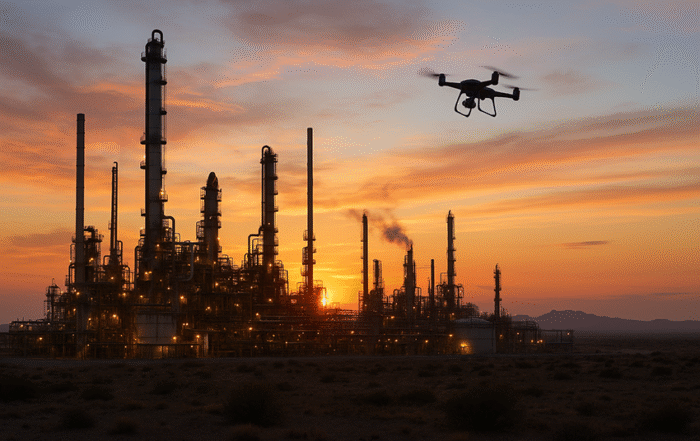
Securing Oil & Gas in the Age of Evolving Threats
Securing Oil & Gas in the Age of Evolving Threats When most people think of oil & gas security risks, they picture Hollywood-style explosions. The reality is far less cinematic—and far more complicated.
The Challenges of Navigating Compliance and Buying Down Risk
The Challenges of Navigating Compliance by Buying Down Risk In today's dynamic energy landscape, private utility providers face immense pressure to comply with stringent regulatory standards while ensuring the security of their operations. The